In reaction to government arts funding cuts, Leeds Metropolitan University in partnership with Culture Vulture and the Audience Agency, initiated a public debate at which a panel of industry experts debated what arts funding is for and who is most deserving of it. A short provocation by Susan Jones argued for more recognition and resources for artists and individuals to counteract the slow, ponderousness of institutions whether for the arts or otherwise. View the whole event including the audience ‘question time’ at the end using the link provided.
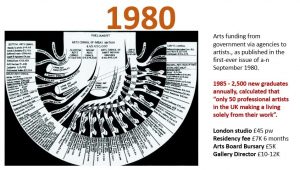
This audio of a presentation by Susan Jones at Work and Art, CRATE, UCA Canterbury, March 2015, considers the climate for visual artists’ practice and their ability to make a living. Referencing evidence and data from arts and cultural sources over the last thirty years and considering insight from future forecasting, it identifies the prevailing issues surrounding support to artists and their livelihoods within the public sector. It concludes by articulating some of the inherent issues and challenges within the current and future ecology for artists and the contemporary visual arts to be addressed by public funders and the sector alike.
Drawing together comparative datasets and commentary, this paper presented in 2011 is an exploration of the concept of ‘too many artists’ within discussion of the underlying premise of state interventions into the arts and differing policy perceptions over time of the artist’s role in society.
A debate instigated in the House of Lords that put a spotlight on the artists’ role acted as catalyst to discuss the implications for future support for artists through arts policy.
Even in countries where there are well-developed fee and pay systems, there is evidence to demonstrate that artists’ wages remain unacceptably low. This is a baseline problem that few in the infrastructures for the arts seem willing to tackle and resolve.