equity (9)

Locative art practices

Within the contemporary visual arts and the development and delivery infrastructures steadily built – and then shored up – since the Millennium, visual artists are characterised as a malleable, mobile workforce – as an ever-ready, imagination-rich resource of arty pitchers and hustlers for bits and bobs.
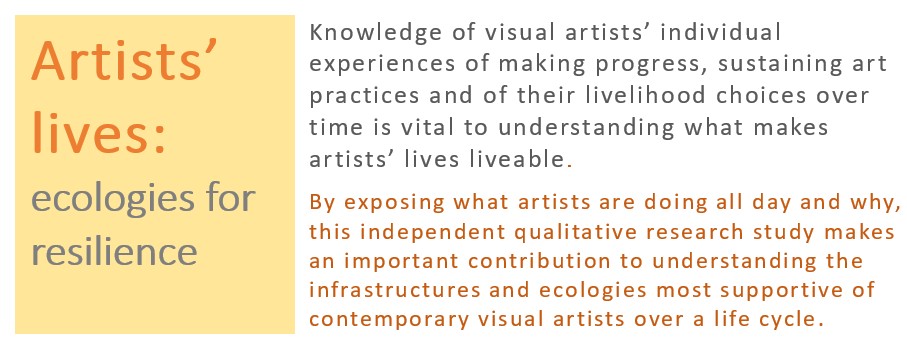
Artists' lives: ecologies for resilience

An independent, qualitative and longitudinal study of the lives of fourteen artists identifying the key factors affecting their practices and resilience in the context of arts policy, economic challenges and social dynamics. Arts Council England made resilience in the arts a strategic policy goal in the austerity period after 2010.

Demographics and economics of artists

Policy and many of the programmes intended to be supportive of artists’ development and careers may lack insight into the nuance of artists’ lives and how they pursue art practices. By collating data from a range of authoritative sources, this new independently produced resource provides a demographic and economic profile of artists as an aid to those committed to aiding artists’ to survive and (maybe even) to thrive, a bit.

Turning the tables: strategies for artists’ equity 

Presentation at the Aberdeen Mini-Summit on Artists’ Exploitation 16 July 2023 on the problematic conditions for artists’ practices and lives that affect their contributions to contemporary visual arts and society intended to inform strategies and infrastructures to secure artists’ social and economic status.

Support for artists' livelihoods in a Covid-19 world 

 This submission was made in June 2020 to the DCMS Committee considering the impact of Covid-19 on any sectors under the Department for Digital, Culture, Media and Sport’s remit. It contextualises artists’ livelihood frameworks and sectoral artistic and economic opportunity, highlighting key challenges and barriers faced by this particular sub-section of the creative industries.

Enforcement, equanimity and an afterword – thoughts on sustaining fair pay for artists

Introduction to fees to artists for exhibiting in public with examples indicating that sustaining such schemes is dependent on widespread and continued acceptance of the principle and rigorous self-regulation within the sector and on gaining suitable levels of public subsidy to the visual arts. Three financing options are considered in support of equanimity. An afterword considers whether in a political climate of reduced subsidy to the public sector, some new strategies are needed to finance the arts and artists’ contributions.